FAQ
Lost – and still relaxed
Our FAQ explains what needs to be done after a loss or theft – and how GLOBALBACK helps you prepare.
- Lost your keys? What to do – and what it can cost
- Lost your wallet? What to do now
- Luggage lost? How to get your bags back
- Phone lost or stolen? What matters now
- Laptop lost or stolen? What to do now
- Tablet or iPad lost? The most important steps
- Camera lost or stolen? What helps now
- USB stick or hard drive gone? Why it hurts
- E-bike stolen? What to do now
- Bicycle stolen? What to do now
- Why should a GBID definitely go on the sleeve of your debit and credit cards?
- Why should a GLOBALBACK card (with GBID and QR code) be in every wallet and every bag?
Answer 1
Lost your keys? What to do – and what it can cost
You reach into your pocket, feel nothing, and your stomach drops: your keys are gone. Few everyday losses cause panic this quickly – because a single ring often holds your front door, your flat, your car, your mailbox and sometimes even your office.
Lost your keys – what to do first
In the first few minutes, a clear head helps more than panic. Retrace your last stops: where were you, and when did you last hold the keys? Very often they are still at the café, in a shopping trolley, at the gym, or have simply slipped between the sofa cushions.
If the search turns up nothing, consider which locks the key opens and whether a stranger could take advantage. With a plain front-door key and no address attached, the risk is low. It becomes more serious if an ID card, an address tag or a business card hangs on the same ring – then a finder may know immediately which door the key fits. For that reason alone: never write your address on your keyring.
Why losing keys can become expensive
Many people underestimate the costs a lost key can trigger. It is rarely about the piece of metal itself.
- Car keys: Modern vehicle keys with an immobiliser or keyless-go function have to be re-coded and programmed. Depending on the make and model, this can quickly run into several hundred or even a few thousand in currency.
- Master key systems in apartment buildings: If your key belongs to a central locking system, the entire system may need replacing in the worst case – and those costs are often charged to whoever lost the key.
- Office and building keys: With commercial locking systems the consequences are often even greater, because many doors and users are affected.
These potential costs are the main reason why the quick return of a found key is so valuable. The sooner your key comes back, the more likely you avoid an expensive replacement altogether.
The real problem: a found key says nothing
Picture the situation from the finder's point of view. Someone spots a set of keys on the pavement or in a café. The honest wish to return them is there – but how? A key reveals nothing about its owner. No name, no phone number, no way to make contact.
And that is a good thing: if your name and address were on it, every finder would know exactly which door those keys open – a serious security risk. But it leaves the honest finder helpless. The keys often end up at a lost-property office eventually, and sometimes nowhere at all. This is exactly the gap that GLOBALBACK closes.
The solution: a GBID on your keyring
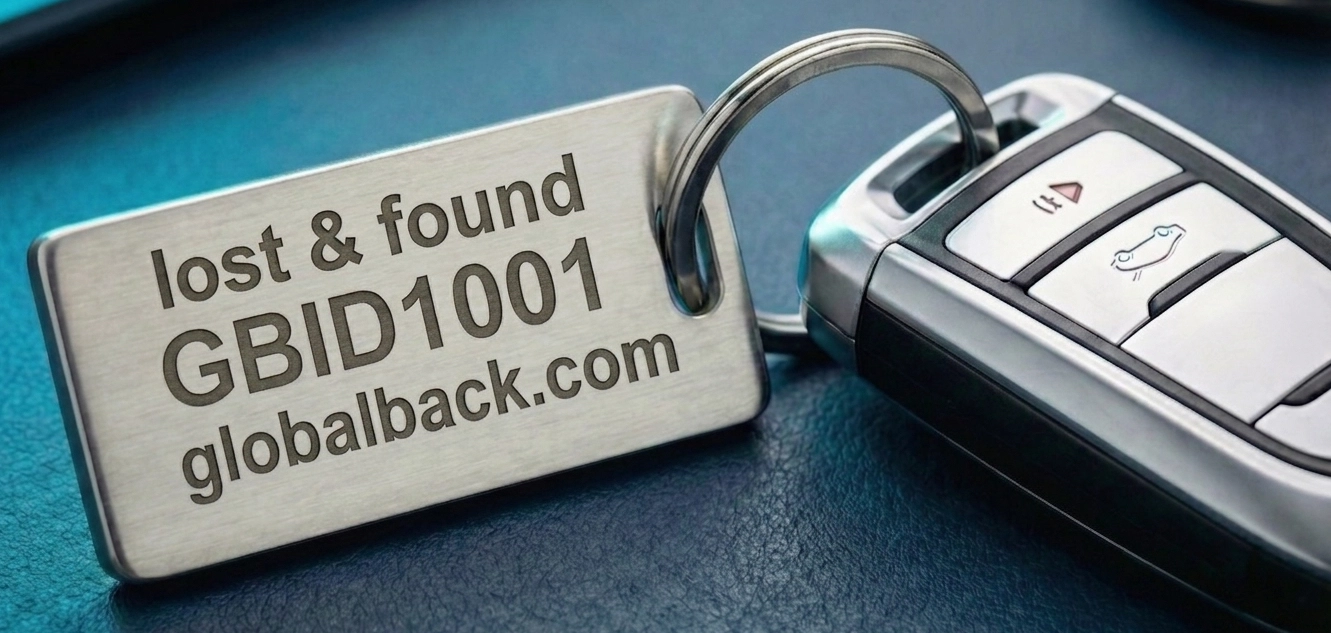
The GLOBALBACK identification number (GBID) is a globally unique number that you attach to your keyring as a sturdy tag. The finder sees straight away that these keys are marked and can be returned – without a single private detail about you becoming visible. Neither your name, nor your address, nor the lock they belong to can be identified.
How the return works – no app needed
The finder simply enters the GBID on the GLOBALBACK home page, or scans a QR code if you use one on your tag. No app and no user account are required. They can then send you a message through a contact form. It reaches you by email, and you decide whether and how to respond.
Your data stays protected
Your contact details are not visible to the finder. If you wish, you can additionally store a phone number for finders with each GBID in your GLOBALBACK account – entirely optional. That way you always stay in control of what you share.
The time factor: often faster than a lost-property office
The greatest advantage of a marked item is speed. A finder who sees a clear way to return something usually acts immediately – they do not have to carry the keys around for days or make a trip to the nearest lost-property office. In the best case, the first message reaches you before you even notice the loss.
That speed matters especially with keys. As long as they are already on their way back to you, there is often no need to call an emergency locksmith or replace a locking system.
Common questions about lost keys
Should I report lost keys to the police?
A simple loss with no sign of a break-in is usually a matter for a lost-property office rather than the police. It is different if the keys were stolen, or if you suspect someone knows your address – then reporting it can make sense.
When does a locking system have to be replaced?
That depends on the individual case, in particular on whether the key can be linked to a specific flat or address. Your landlord or property manager decides whether a replacement is necessary. This is precisely why it is so valuable when keys find their way back to you quickly and without a readable address.
Does a GBID also help with car or bicycle keys?
Yes. A GBID can be attached to virtually any keyring – whether it holds house, car or bicycle keys. It marks the set as a whole and makes contact by an honest finder possible.
Conclusion: prevention is the best protection against the shock
You only get lost keys back quickly if an honest finder has a way to reach the owner at all. A GBID on your keyring creates exactly that – visible to the finder, protected for you, and without revealing your address to strangers.
The solution is here – you just have to use it.
Answer 2
Lost your wallet? What to do now
That moment at the checkout when your hand finds nothing: no wallet in your pocket. Losing a wallet is one of the most stressful mishaps in everyday life – not because of the cash, but because of everything else inside: your ID card, driving licence, debit and credit cards, health insurance card and often a stack of loyalty cards too.
Lost your wallet – these steps matter immediately
Once it is clear that your wallet is gone, every minute counts for your payment cards. Contact your bank or card issuer straight away and have your debit and credit cards blocked. Many banks offer a dedicated blocking hotline, and in some countries there is a central number for this purpose – check the details of your own provider and keep them somewhere separate from your wallet.
Next come your identity documents. A lost ID card or driving licence usually has to be reported and reissued by the responsible authority, which means appointments, waiting times and fees. Your health insurance card should also be blocked and replaced through your insurer.
Important: Do not wait to block your cards. As soon as you know your wallet is gone, have your payment cards blocked – this protects you from financial damage and always comes first. If an honest finder reaches you so quickly that you had not even noticed the loss, the whole effort resolves itself anyway.
The problem: the finder has no phone number
An honest finder who picks up your wallet faces a surprising problem. Your ID card shows a name and an address, but no phone number and no email. So the finder would either have to travel across town to your address, or make a trip to a lost-property office or police station. Both take effort, and both are easily postponed to "tomorrow".
For you, that "tomorrow" means an anxious night with blocked cards and open questions. Meanwhile the finder would often be happy to get in touch straight away – if only there were a simple way.
The solution: a GBID card in credit-card format
This is where the GLOBALBACK identification number (GBID) comes in. You place the GBID as a card in handy credit-card format clearly visible in a slot of your wallet – for example behind a transparent window. The finder sees the card and its QR code the moment the wallet is opened.
One scan is enough
The finder scans the QR code with a smartphone or enters the number on the GLOBALBACK home page – no app, no registration. Through a contact form they can send you a message, which reaches you by email. Your contact details stay invisible, and you decide whether and how to respond.
The time factor: often faster than you notice the loss
The great advantage of the GBID card is speed. If your wallet slips out of your bag in a café or stays behind at a supermarket till, the next customer or a member of staff often picks it up while you are still in the shop. A quick scan – and you can be reached before you have even realised anything is missing.
In the best case your wallet is already on its way back to you while you still knew nothing about its loss. If it returns that quickly, the entire effort around blocked cards and replacement documents resolves itself.
Privacy: GLOBALBACK stores no sensitive data
This is an important point, especially for a wallet: GLOBALBACK neither needs nor stores your bank account details, ID numbers or credit card data. The GBID simply marks your wallet and enables contact through the finder form. No sensitive banking data sits anywhere online – you keep full control over your information.
Common questions about a lost wallet
Should I report the loss to the police?
For a simple loss, reporting it to a lost-property office is usually enough. If your wallet was stolen, a police report makes sense – not least because some insurers and authorities require one.
Do I really have to reapply for my ID card?
If the document is definitively lost, there is generally no way around applying for a replacement with the responsible authority. If your wallet comes back to you quickly, however, that step becomes unnecessary.
Does the GBID card work abroad?
The GBID is a globally unique number and contact runs over the internet. An honest finder can therefore reach you from anywhere, including from another country.
Conclusion: prevention creates a short line to the finder
A GBID card with a QR code in your wallet is the simple, fast and privacy-friendly bridge between you and an honest finder. The sooner they can reach you and report the find, the better the chance your wallet comes back quickly – provided the card is already inside before anything happens.
The solution is here – just tuck it in.
Answer 3
Luggage lost? How to get your bags back
The baggage belt turns, slows down, and eventually only one certainty remains: your suitcase is not coming. Or you step off the train and realise on the platform that your travel bag is still in the carriage. Losing luggage is one of the most frustrating experiences when travelling – and it happens more often than most people think.
Luggage lost – the first steps
If your baggage disappears at the airport, your first stop is your airline's lost-and-found desk. There you file a loss report and receive a reference number. Note down your flight details, any stopovers and an exact description of the suitcase, because you will be asked for all of it.
If a bag stays behind on a train, a bus or in a hotel, contact the lost-property service of the operator or the property in question. The more precisely you can describe the item, and the faster you react, the better your chances of getting it back.
The security risk of classic luggage tags
Many travellers write their name, phone number and full address on their luggage tag. It is well meant, but it can become a problem: an openly readable address tag tells anyone who sees it that this person is away travelling and their home is probably empty. At a busy airport, that is information you would rather not hand to strangers.
At the same time, an honest finder needs some way of reaching you. With no marking at all, an unclaimed suitcase ends up in a lost-property office at best – and stays untraceable at worst. So what is needed is a solution that lets the finder reach you without exposing your private details.
The solution: a GBID on your luggage
The GLOBALBACK identification number (GBID) is a globally unique number that you attach to a suitcase, travel bag or backpack as a sturdy tag. The finder – whether airport staff, train personnel, a taxi driver or a hotel employee – immediately recognises that this item is marked and can be returned. Your personal data stays completely hidden.
How the return works
The finder enters the GBID on the GLOBALBACK home page or scans a QR code if you use one – no app, no registration. Through a contact form they send you a message, which reaches you by email. You decide whether and how to respond, and your contact details stay invisible to them.
The time advantage with missing baggage
With misrouted air baggage in particular, every hour counts. An attentive employee who finds a marked suitcase has an immediate way to inform the owner. In the best case you already know your suitcase has been found while the airline's own search is still running.
That head start is valuable: the sooner contact is made, the more smoothly the return can be organised – and the less often a misplaced suitcase turns into a permanent loss.
Why describing your suitcase matters
At the airport, with a railway operator or at a lost-property office, you will always be asked to describe your suitcase as precisely as possible. Brand, colour, size and distinguishing features such as stickers, straps or scratches all help to identify your item. It is worth putting these details together calmly before you travel, so you do not have to think hard in a stressful moment.
A plain, single-colour suitcase with no features is harder to recognise than one with a clear marking. A clearly visible GBID on the handle not only makes your suitcase identifiable, it also signals to an honest finder that it can be returned.
Suitable for every kind of travel
Whether you fly, take the train, go on a cruise, travel by coach or by car: wherever luggage leaves its owner's sight – at check-in, in a luggage compartment, at a hotel reception or on a bus – a marking can make the difference. School bags, sports bags and instrument cases can be protected in exactly the same way. The principle is always the same: visible to the finder, protected for you.
Common questions about lost luggage
How long does it take for lost air baggage to come back?
In many cases misrouted baggage reappears within a few days and is delivered on. Only when a suitcase remains untraceable for a longer period is it officially considered lost. An additional marking increases the chance that an honest finder gets in touch independently of the airline process.
What is better than an address tag?
A GBID has a clear advantage over the classic address tag: it enables contact without revealing your name and address. That way you combine findability with privacy.
Can I mark several pieces of luggage?
Yes. You can give every item its own GBID – practical if you travel with several suitcases or as a family.
Conclusion: safe travel starts at the baggage belt
A lost suitcase can only be returned quickly if an honest finder has a way to reach you. A GBID on your luggage creates exactly that – visible to the finder, protected for you, with no readable address.
The solution is here – you just have to use it.
Answer 4
Phone lost or stolen? What matters now
A quick reach into your pocket, the familiar feel of glass – your phone is there. But what if it suddenly is not? Stolen in a crowd, left behind in a taxi, or destroyed after a fall? The loss hits harder than most people expect, because a smartphone stopped being a telephone long ago. It is the control centre of our digital lives.
Phone lost – the first steps
Act quickly, but in the right order. These measures matter most in an emergency:
- Locate and lock: Services such as "Find My Device" (Android) or "Find My" (Apple) let you locate the device remotely, lock it and, if necessary, erase it.
- Block the SIM card: Call your mobile provider and have the SIM blocked to prevent misuse and unexpected charges.
- Stop payment services: Deactivate mobile payment services and keep an eye on your account.
- Change passwords: Change the passwords of your most important services, starting with your email account.
Why losing a phone has so many consequences
The material value is often the smallest problem. Far more serious are the dependencies we rarely think about in everyday life.
The two-factor trap
Almost every online service now uses two-factor authentication. The confirmation message or the authenticator app runs on exactly the device that is now missing. The result: you may be locked out of your own accounts – and without access to your email inbox you often cannot even reset passwords.
Irreplaceable memories
Photos and videos from recent years are gone for good without a backup. A device can be replaced, moments cannot. A regular, automatic backup to a secure photo cloud is therefore the single most important precaution you can take.
Financial risk
If thieves have watched you enter your unlock code, amounts can be charged through mobile payment services within a short time. This is why blocking everything quickly is so crucial.
Building block 1: the GBID – your line to the finder
A modern smartphone is perfectly protected against unauthorised access. That is ideal for security, but a problem if it is lost: an honest finder faces a locked display and has no idea who the device belongs to.
The GLOBALBACK identification number (GBID) closes that gap. Because GLOBALBACK does not prescribe rigid ready-made products, you mark your device however it suits you. A popular option: store the GBID as a digital lock screen. That way the finder sees a globally unique number right on the display.
How the return works
The finder enters the GBID on the GLOBALBACK home page or scans a QR code – no app, no registration. Through a contact form they send you a message, which reaches you by email. Your contact details stay protected.
Building block 2: the GLOBALBACK cloud – making resale harder
Completely independently of the GBID, you can also register your smartphone in the GLOBALBACK cloud. There you enter the device with its serial number (required) and optionally its IMEI numbers, and give it a status – such as "Lost" or "Stolen". For "Stolen" you can additionally store a police reference number, which the connected check portals display as well.
What is the IMEI number?
The IMEI (International Mobile Equipment Identity) is a globally unique 15-digit serial number – comparable to the chassis number of a car. You can retrieve it free of charge by entering *#06# in your phone app. Note it down in good time, because once the device is gone it is too late.
- Checkable worldwide: Your registered device can be looked up by serial and IMEI number on portals such as seriennummern-check.de, ebike-check.online, checkmich.online and checkme.website.
- A warning for buyers: If your device is marked "Lost" or "Stolen", potential buyers see a warning immediately when they run a number check. This makes reselling stolen goods considerably harder and increases the risk for thieves and dishonest finders, because an attentive buyer sees the entry.
Common questions about a lost smartphone
Can a stolen phone be traced using the IMEI?
The IMEI primarily serves to identify the device uniquely, not to locate it. For locating, use the services built into your operating system. In the GLOBALBACK cloud, the IMEI makes the device identifiable as lost or stolen.
Do I need a GBID to use the cloud?
No. The GBID and the cloud are two separate offerings. You can register your smartphone in the cloud, use a GBID to mark it – or combine both.
What does a police reference number add to the entry?
If a reference number is stored with the "Stolen" status, the check portals display it too. This underlines that the entry is serious and can help when clarifying a case.
Conclusion: two building blocks for your digital life
The GBID brings your smartphone back through an honest finder. The GLOBALBACK cloud makes a stolen device identifiable to buyers and therefore harder to resell. You can use either building block on its own or both together – combined with a regular backup, you are as well prepared as possible.
The solution is here – you just have to use it.
Answer 5
Laptop lost or stolen? What to do now
You glance into your backpack and your heart skips a beat: the laptop is gone. Whether it was left on a luggage rack, forgotten in a café or stolen from a car, losing a notebook hits twice. It is an expensive device, and at the same time it holds your work, your documents and your personal files.
Laptop lost or stolen – the first steps
- Protect your accounts: Immediately change the passwords of your most important services – email, cloud storage, social networks. Where possible, sign out remotely from all devices.
- Use remote access: Many operating systems offer a function to locate, lock or erase a device remotely. Check whether it is active on your machine.
- Report the theft: If your laptop was stolen, file a police report. For the report and for your insurer you will need the exact serial number and model designation.
- Inform your insurer: Check whether a home contents or electronics policy covers the loss.
Tip: Note down the serial number, model and purchase date of your laptop now, and keep those details separately from the device. In an emergency you will have everything to hand that the police and your insurer ask for.
Why data protection matters especially with a laptop
Over the years, sensitive data accumulates on a notebook: work documents, private photos, saved passwords and access to online services. If the device falls into the wrong hands, the potential damage far exceeds the cost of replacing it.
A strong login password and full-disk encryption are therefore the foundation of any precaution. They ensure that a stranger cannot simply access your data – and at the same time make the device far less useful to thieves.
Building block 1: the GBID – your line to the finder
A closed laptop tells the finder nothing about its owner, and it is locked. There is no way for them to know whose it is – unless you had stuck your private details on it, which would be a bad idea for security reasons.
The GLOBALBACK identification number (GBID) solves this. Whether as a discreet, high-quality sticker on the case or as a marking on the bag, the GBID gives your laptop a globally unique number while your personal data stays completely hidden.
How the return works
An honest finder enters the GBID on the GLOBALBACK home page or scans a QR code – no app, no registration. Through a contact form they send you a message, which reaches you by email. Your contact details stay invisible to them.
Building block 2: the GLOBALBACK cloud – making resale harder
Independently of the GBID, you can also register your laptop in the GLOBALBACK cloud. You enter the device with its serial number and give it a status – such as "Lost" or "Stolen". For "Stolen" you can additionally store a police reference number, which the check portals display as well.
- Checkable worldwide: Using the serial number, your registered device can be looked up on connected check portals such as checkmich.online and checkme.website.
- Higher risk for thieves: If your laptop is marked "Lost" or "Stolen", potential buyers see a warning immediately when they run a serial number check. That makes reselling noticeably harder and increases the risk for thieves, because an attentive buyer sees the warning.
Common questions about a lost laptop
Where do I find my laptop's serial number?
The serial number is usually on a label on the underside of the device, often also in the system information of your operating system and on the original packaging or purchase receipt.
Is registering still worthwhile after a theft?
Registration is most effective before a loss. But even afterwards, an entry marked "Stolen" can help, provided you still know the serial number – which is exactly why it is worth noting it down separately.
Can I use the GBID and the cloud together?
Yes. They are independent of each other. The GBID aims at return by a finder, the cloud at making a resale harder. Together they cover both scenarios.
Conclusion: protecting hardware and data at the same time
The GBID is your direct line to the finder, and the GLOBALBACK cloud makes a stolen notebook identifiable to buyers, which makes reselling harder. Together with a strong password, encryption and regular backups, you protect not just the device but all of your digital work.
The solution is here – you just have to use it.
Answer 6
Tablet or iPad lost? The most important steps
On the train, in a café, in a waiting room or on the sofa – a tablet is the ideal companion at home and on the move. That same mobility also makes it vulnerable to loss and theft. And just like a smartphone, an iPad or Android tablet holds far more than expensive technology: photos, documents, emails, saved logins and entire digital habits.
Tablet lost – the first steps
- Locate and lock: Use "Find My" (Apple) or "Find My Device" (Android) to locate the tablet, lock it remotely and erase it if necessary.
- Secure your accounts: Change the passwords of your most important services and sign the device out of any linked accounts.
- Block mobile service: If your tablet has a SIM card or eSIM, have it blocked by your provider.
- Report a theft: In case of theft, file a police report. Have the serial number and model ready.
Tip: Note down your tablet's serial number in good time. On many devices you will find it in the settings under "About" or "About this device", as well as on the original packaging.
Why losing a tablet is more than losing hardware
A tablet accumulates much the same sensitive data as a computer: email accounts, cloud services, saved passwords and sometimes banking apps. A strong unlock code and, where available, biometric protection are therefore essential. They make sure a stranger cannot simply access your data.
Two-factor authentication can be affected too, if confirmation codes arrive on the tablet. Check whether your most important accounts are also secured through a second device.
Building block 1: the GBID – your line to the finder
A locked tablet tells the finder nothing about its owner. The honest wish to return it often fails simply because there is no way to make contact.
The GLOBALBACK identification number (GBID) closes that gap. You can store the GBID as a digital lock screen, or attach it as a discreet sticker to the case or cover. Either way the finder immediately sees a globally unique number, without any private data becoming visible.
How the return works
The finder enters the GBID on the GLOBALBACK home page or scans a QR code – no app, no registration. Through a contact form they send you a message, which reaches you by email. Your contact details stay protected.
Building block 2: the GLOBALBACK cloud – making resale harder
Independently of the GBID, you can register your tablet in the GLOBALBACK cloud. You enter the device with its serial number and give it a status – such as "Lost" or "Stolen". For "Stolen" you can additionally store a police reference number, which the check portals display as well.
- Checkable worldwide: Using the serial number, your registered tablet can be looked up on connected check portals such as seriennummern-check.de, checkmich.online and checkme.website.
- A warning for buyers: If your tablet is marked "Lost" or "Stolen", potential buyers see a warning immediately when they run a serial number check. That makes reselling stolen goods harder and increases the risk for thieves and dishonest finders.
Common questions about a lost tablet
Does this apply to iPads as well?
Yes. Whether it is an iPad or an Android tablet makes no difference. What matters for cloud registration is that the device has a unique serial number; a GBID can be attached to any model.
What is the difference between the GBID and the cloud?
The GBID aims at return by an honest finder, the cloud at making a resale harder. The two are independent and can be used separately or together.
Can I register my tablet after the event?
Yes, as long as you know the serial number. Prevention is most effective, however, when it happens before a loss.
Conclusion: two building blocks for your tablet
The GBID brings your tablet back through an honest finder. The GLOBALBACK cloud makes a stolen device identifiable to buyers and harder to resell. With a strong password and regular backups you are protected on top of that.
The solution is here – you just have to use it.
Answer 7
Camera lost or stolen? What helps now
A camera accompanies its owner to the most beautiful places – and that is exactly where it is most easily lost: travelling, on day trips, at events. Whether it is a DSLR, a mirrorless system camera, an action cam or a compact model, the loss hurts twice over. Alongside the high purchase price, the memory card often holds irreplaceable images.
Camera lost – the first steps
- Retrace your stops: Go through the places you visited – cameras are frequently left in cafés, at viewpoints, on public transport or at event venues.
- Contact lost-property offices: Report the loss to the lost-property services of the places you were – railway operators, museums, event organisers, local authorities.
- Report a theft: If your camera was stolen, file a report. You will need the serial number and the model designation.
- Check your insurance: High-value photographic equipment is sometimes covered by home contents or a dedicated photography policy.
Tip: Every camera has a unique serial number, usually on the base of the body and in the menu information. Note it down in good time together with the model – in case of loss it is the single most important detail.
Why cameras get lost so often
Cameras are constantly in motion: taken out of a bag, hung around the neck, briefly put down and packed away again. That is exactly when it happens – the camera stays on a bench, slips out of an open bag, or is forgotten in the bustle of an event. Unlike a smartphone, which we hold every few minutes, a camera is only used now and then and is therefore far easier to overlook.
Building block 1: the GBID – your line to the finder
A found camera tells its finder nothing about the owner. Even looking through the images rarely reveals a name or a way to get in touch – and sticking private contact details on the body would be a bad idea.
The GLOBALBACK identification number (GBID) provides the answer. As a discreet, sturdy sticker on the body or on the camera bag, it gives the device a globally unique number without revealing a single private detail about you.
How the return works
The finder enters the GBID on the GLOBALBACK home page or scans a QR code – no app, no registration. Through a contact form they send you a message, which reaches you by email. Your contact details stay protected.
Building block 2: the GLOBALBACK cloud – making resale harder
Independently of the GBID, you can register your camera in the GLOBALBACK cloud. You enter the device with its serial number and give it a status – such as "Lost" or "Stolen". For "Stolen" you can additionally store a police reference number, which the check portals display as well.
- Checkable worldwide: Using the serial number, your registered camera can be looked up on connected check portals such as seriennummern-check.de, checkmich.online and checkme.website.
- A warning for buyers: Used cameras are often sold through second-hand platforms and flea markets. If your camera is marked "Lost" or "Stolen", buyers see a warning immediately when they run a serial number check – which makes reselling stolen goods considerably harder.
Common questions about a lost camera
Can I mark lenses as well?
Lenses and other accessories with their own serial number can be registered as separate items in the cloud. For physical return you can additionally mark the camera and its bag with a GBID.
What about the photos on the memory card?
The best precaution against losing images is a regular backup of your shots. That way your photos are safe even if the camera itself does not come back.
Is registration worthwhile for older cameras?
Yes. What matters is not the age but whether the device has a unique serial number by which it can be identified.
Conclusion: two ways to protect your camera
The GBID brings your camera back through an honest finder. The GLOBALBACK cloud makes a stolen device identifiable to buyers and harder to resell. Combined with a regular backup of your images, you are well prepared.
The solution is here – you just have to use it.
Answer 8
USB stick or hard drive gone? Why it hurts
A USB stick is barely bigger than a thumb, and an external hard drive fits into any jacket pocket. That handiness is exactly what makes them so practical – and so easy to lose. They stay plugged into a library computer, slip out of a laptop bag, are left behind in a meeting room or vanish into a moving box.
The bitter part: these small devices usually hold what we consider especially important. That is precisely why we saved it there.
What you lose along with a data carrier
Many people underestimate how much accumulates on such a small device. Typically:
- The photo archive: Holiday pictures, family celebrations, years of photos of the children – often moved off the computer because it was full. And that is exactly when the external drive becomes the only copy.
- Work documents: Presentations, project files, client data, invoices. With professionally used data carriers, data protection quickly becomes an issue too.
- Coursework and theses: Months or years of work, sometimes without an up-to-date second copy.
- The backup itself: Particularly cruel – the drive that was meant to be your safety copy is suddenly the lost item.
- Personal documents: Scanned contracts, certificates, copies of ID documents, tax paperwork.
The purchase price of a stick or a drive is almost never the problem. The device is easy to replace – its contents often are not.
Why data carriers get lost so often
USB sticks and external drives share a characteristic that makes them especially vulnerable: they are constantly on the move but rarely in sight. Unlike a phone, which we pick up every few minutes, a stick disappears into a side pocket and is not needed again for weeks. Until then, nobody notices it is missing.
On top of that, data carriers are often passed around, lent out or used on other people's computers. A stick left in a print shop computer or in a conference presentation machine is a classic. And because the device itself is worth little, few people go to much trouble to find the owner – unless you make it easy for them.
The most important protection first: encryption
Before we come to getting it back, one point matters even more: an unencrypted data carrier can be read by anyone who finds it. Unlike a smartphone there is no lock screen – whoever plugs the stick in sees everything at once.
So encrypt your data carriers, especially if they hold professional or sensitive private data. Windows, macOS and Linux all include suitable built-in tools, and there are free programs that do the job. That way your data stays unreadable even if the device ends up in the wrong hands.
Important to know: A GBID ensures that an honest finder can reach you. It cannot prevent anyone from reading the data. That part is handled by encryption alone – only together do the two add up to sensible precaution.
Equally important: the second copy
A single external hard drive is not a backup, just another place where data happens to sit. A real backup means the same data exists in at least two separate places. Only then is losing a device annoying rather than painful.
With a photo archive in particular, that effort pays off. Anyone who also keeps their images on a second data carrier or in cloud storage loses only hardware when a stick goes missing – not memories.
The GBID – so an honest finder can reach you
And here is the underlying problem: a found USB stick reveals nothing about its owner. At best the finder could look through the files – which they cannot do with encrypted data, and should not do with unencrypted data either. Without a marking, the stick ends up in a drawer or in the bin.
The GLOBALBACK identification number (GBID) solves exactly that. As a small, sturdy sticker on the casing of a hard drive, on the stick itself or on its lanyard, it gives the data carrier a globally unique number – without revealing your name, your address or any other private detail.
How the return works
The finder enters the GBID on the GLOBALBACK home page or scans a QR code – no app, no registration. Through a contact form they send you a message, which reaches you by email. Your contact details stay protected, and you decide whether and how to respond.
The quiet advantage with data carriers
Because a missing stick is often noticed late, a marking is particularly valuable here: the finder can get in touch long before you even miss the device.
Optional: external drives in the GLOBALBACK cloud
If your external hard drive carries its own serial number on the casing, you can additionally register it in the GLOBALBACK cloud – entirely independently of the GBID – and give it a status such as "Lost" or "Stolen". For "Stolen" you can store a police reference number, which the connected check portals display as well.
Simple USB sticks usually lack such a number. Here the GBID remains the right approach: it is what makes the stick identifiable in the first place.
Common questions about lost data carriers
I found a USB stick – should I plug it in?
Better not. Unknown data carriers can contain malware, and looking through someone's private files is questionable anyway. If a GBID is attached, you can reach the owner without ever plugging the stick in.
Where do I put a GBID on a tiny stick?
On very small sticks, the lanyard, a tag or the protective cap work well. On external hard drives, the top or bottom of the casing is ideal – the sticker does not get in the way there and is still immediately visible.
Is this worthwhile for memory cards too?
SD and microSD cards themselves are too small to mark. Instead it makes sense to put a GBID on the card case, the pouch or the camera bag.
Conclusion: small device, big loss
With USB sticks and external hard drives it is almost never about the value of the hardware, but about what is stored on it. Encryption protects your data from prying eyes, a second backup protects it from being lost for good – and the GBID makes sure an honest finder can reach you at all.
The solution is here – you just have to use it.
Answer 9
E-bike stolen? What to do now
An e-bike is a purchase that quickly runs into several thousand – and unfortunately a popular target for thieves. Whether outside a supermarket, at a station or from a cellar, pedelecs and e-bikes disappear frequently, and it hurts when a prized machine is suddenly gone.
E-bike stolen – the first steps
- File a report: Report the theft to the police straight away. You will need the frame number and ideally the numbers of the other components.
- Inform your insurer: Many e-bikes are covered by a specialist bicycle policy or an extended home contents policy. Report the loss promptly.
- Search the area: Stolen bikes are sometimes parked nearby or stripped for parts. A look around the neighbourhood and at local selling platforms can pay off.
- Set the status: If you registered your e-bike in the GLOBALBACK cloud, set it to "Stolen" now.
Important: The frame number is the central identifier of your e-bike. It is usually stamped into the frame (often near the bottom bracket) and also appears on your purchase documents. Note it down – along with the numbers of the motor, battery and display – as soon as possible.
Why e-bikes are particularly at risk
E-bikes are valuable, mobile and easy to resell – an attractive combination for thieves. Stolen bikes are frequently stripped and sold as individual parts, because a frame, a motor and a battery are harder to trace separately. That is precisely why it makes sense to be able to document not only the bike as a whole, but its individual components too.
Building block 1: the GBID – your line to the finder
If an e-bike is found or turns up somewhere, it tells the finder nothing about its owner. The GLOBALBACK identification number (GBID) changes that: as a sturdy marking on the frame it gives the bike a globally unique number through which an honest finder can make contact – without your personal data becoming visible.
How the return works
The finder enters the GBID on the GLOBALBACK home page or scans a QR code – no app, no registration. Through a contact form they send you a message, which reaches you by email. Your contact details stay protected.
Building block 2: the GLOBALBACK cloud – your e-bike with all its components
This is where an e-bike really benefits. In the GLOBALBACK cloud you register your pedelec not just as a single item, but with up to four individual components: frame, motor, battery and control unit. Each component gets its own manufacturer, model and status. The frame number is mandatory.
You can give each component a status – such as "For sale", "Not for sale", "Lost" or "Stolen". For "Stolen" you can store a police reference number, which the check portals display as well.
- Protection down to the individual part: Because the motor, battery and display can be entered separately, even a stripped bike remains traceable through its components.
- Checkable worldwide: Your numbers can be looked up on the connected check portals – such as ebike-check.online, seriennummern-check.de, checkmich.online and checkme.website.
- A warning for buyers: If a component is marked "Lost" or "Stolen", buyers see a warning immediately when they run a number check – which makes reselling considerably harder.
Common questions about e-bike theft
Where do I find my e-bike's frame number?
The frame number is usually stamped into the frame, often near the bottom bracket, on the seat tube or on the head tube. It also appears on your purchase documents.
Can I transfer individual parts if I sell them?
Yes. In the GLOBALBACK cloud, whole items or individual components can be transferred to a new owner. That keeps the documentation clean even after a sale.
Does the GBID help with a regular bicycle too?
Yes. A bicycle without a motor can also be protected using a GBID and its frame number. You can read more in the next answer, on bicycles.
Conclusion: comprehensive care for your e-bike
The GBID is your direct line to the finder. The GLOBALBACK cloud documents your e-bike down to its individual components and makes a stolen bike – even a stripped one – identifiable to buyers. Two building blocks that together improve your chances of return and make reselling considerably harder.
The solution is here – you just have to use it.
Answer 10
Bicycle stolen? What to do now
Bicycle theft is one of the most common property crimes of all. Every year countless bikes disappear from stations, backyards, cellars and bike racks – and only a small proportion ever finds its way back to the owner. A good bicycle is expensive, and the frustration when it is gone is correspondingly great.
Bicycle stolen – the first steps
- File a report: Report the theft to the police. The frame number is the single most important detail – it identifies your bike uniquely.
- Inform your insurer: Check whether your bike is covered by home contents or a separate bicycle policy, and report the loss promptly.
- Check the area and the platforms: Stolen bikes frequently reappear on second-hand platforms or at flea markets. A watchful eye can pay off.
- Set the status: If your bicycle is registered in the GLOBALBACK cloud, set it to "Stolen" now.
Important: The frame number is the central identifier of your bicycle. It is usually stamped into the frame – often near the bottom bracket, on the seat tube or on the rear dropout – and also appears on your purchase documents. Note it down as soon as possible.
Why so few bicycles come back
The underlying problem: many recovered bikes cannot be matched to an owner, because nobody knows or has documented the frame number. A found bicycle tells its finder nothing about the owner – there is no name, no number, no way to make contact. This is exactly where a marking helps, solving both problems: identification through a registered number, and direct contact through the finder.
Building block 1: the GBID – your line to the finder
The GLOBALBACK identification number (GBID) marks your bicycle with a globally unique number, for example as a sturdy marking on the frame. An honest finder immediately sees that the bike can be returned, without your personal data becoming visible.
How the return works
The finder enters the GBID on the GLOBALBACK home page or scans a QR code – no app, no registration. Through a contact form they send you a message, which reaches you by email. Your contact details stay protected.
Building block 2: the GLOBALBACK cloud – your bike by its frame number
Independently of the GBID, you can register your bicycle in the GLOBALBACK cloud. You enter it with its frame number and give it a status – such as "For sale", "Not for sale", "Lost" or "Stolen". For "Stolen" you can store a police reference number, which the check portals display as well.
- Clearly identifiable: Through the registered frame number your bike can be identified beyond doubt – for instance if it is recovered or offered for sale.
- Checkable worldwide: The number can be looked up on the connected check portals – such as seriennummern-check.de, ebike-check.online, checkmich.online and checkme.website.
- A warning for buyers: If your bike is marked "Lost" or "Stolen", buyers see a warning immediately when they run a number check – which makes reselling stolen goods harder.
Common questions about bicycle theft
What is the frame number and where do I find it?
The frame number is a stamped sequence of letters and digits on the bicycle frame, usually near the bottom bracket. It also appears on your purchase documents. It is the most important detail for identifying a bike beyond doubt.
Is registering still worthwhile after a theft?
Registration is most effective before a loss. But even afterwards an entry marked "Stolen" can help, provided you know the frame number – which is why you should always have it noted down.
Does this apply to children's bikes and cargo bikes?
Yes. Any bicycle with a frame number can be registered, and a GBID can be attached to virtually any frame – from a child's bike to a cargo bike.
Conclusion: so your bike does not become another untraceable case
The GBID is your direct line to the finder, and the GLOBALBACK cloud makes your bicycle clearly identifiable by its frame number and recognisable to buyers as stolen. Two building blocks that together considerably improve the chances that your bike does not become another untraceable case.
The solution is here – you just have to use it.
Answer 11
Why should a GBID definitely go on the sleeve of your debit and credit cards?
Because this small sticker can save you an enormous amount of trouble and legwork. Bank and credit cards are often found by honest people before you have even noticed the loss yourself. If the protective sleeve is marked with a GBID, the finder can contact you immediately. This can save you from the worst-case scenario: the panicked and irrevocable blocking of all your cards. Once blocked, a card can usually not be reactivated – which automatically means filling out forms, often paying fees and going for days without a working card. With the GLOBALBACK system you give yourself the chance to avoid this stress completely, because you know in time.
Answer 12
Why should a GLOBALBACK card (with GBID and QR code) be in every wallet and every bag?
Because it not only helps in the case of a classic loss, but is also worth its weight in gold in the event of theft. When pickpockets strike, they are almost always only after quick cash or expensive electronics. The wallet or handbag – along with driving licence, ID card, keys and irreplaceable personal keepsakes – is usually tossed carelessly into the nearest bush or bin. If an attentive passer-by finds the discarded bag, the clearly visible GLOBALBACK card provides the direct way to you. That way you at least quickly get back the things whose replacement costs the most time, the most money and the most nerves.